

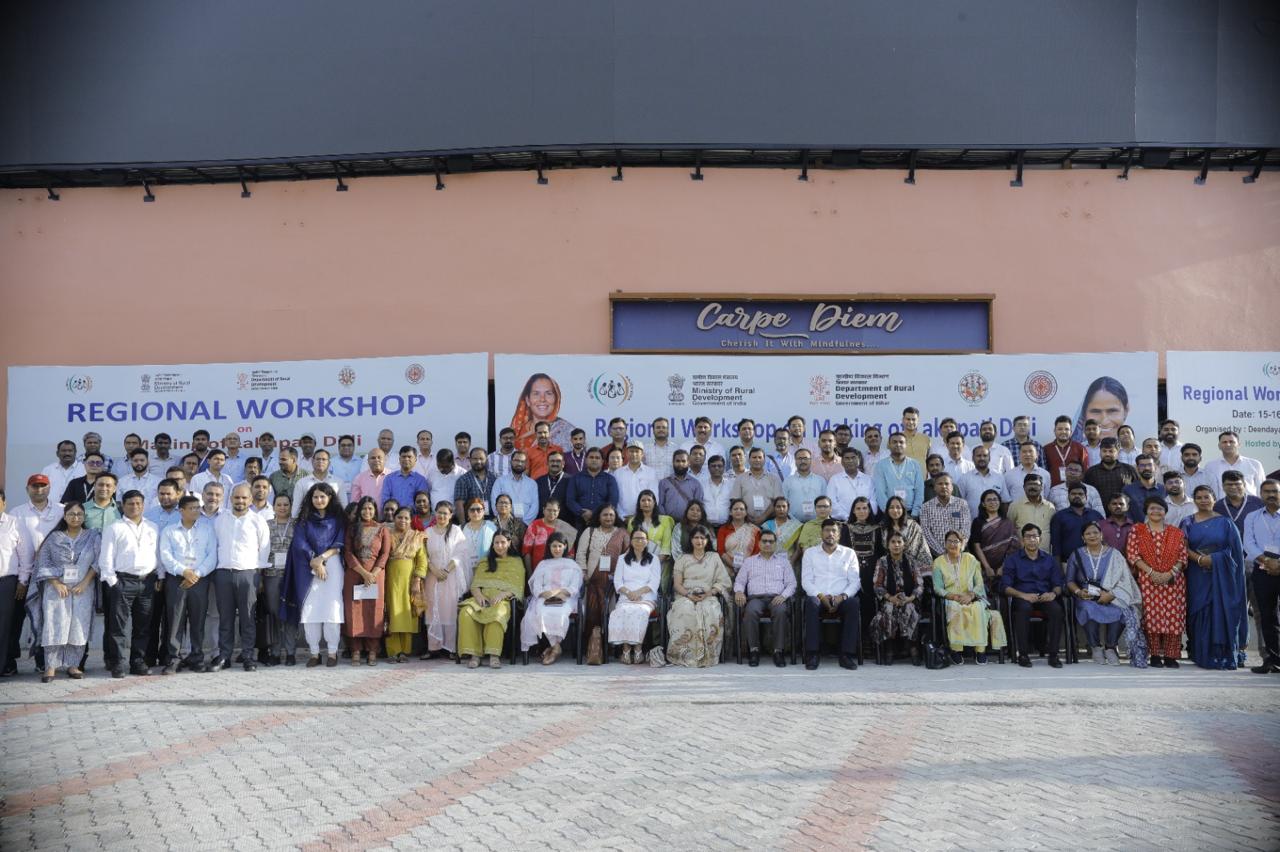
The Government of India has taken another significant step toward empowering rural women by preparing a comprehensive national strategy to achieve the ambitious target of creating 6 crore Lakhpati Didis. A two-day regional workshop titled “Making of 6 Crore Lakhpati Didis: Farm, Non-Farm Livelihoods and MIS Strategy & Roadmap” was organized at the Bihar Institute of Public Administration and Rural Development (BIPARD) in Gaya under the joint aegis of the Ministry of Rural Development and the Bihar Rural Livelihoods Promotion Society (BRLPS–JEEViKA).
The workshop brought together representatives from State Rural Livelihood Missions (SRLMs), policymakers, development partners, technical experts, and livelihood practitioners from across the country. Participants deliberated on strategies to strengthen farm and non-farm livelihoods, improve digital monitoring systems, expand market linkages, promote women entrepreneurship, and reinforce community institutions. The discussions culminated in the preparation of the Annual Action Plan (AAP) for 2026–27 and a national roadmap for achieving the expanded mission.
From 3 Crore to 6 Crore Lakhpati Didis
Addressing the workshop virtually, Rohit Kansal, Secretary, Ministry of Rural Development, said that India has successfully achieved the milestone of creating 3 crore Lakhpati Didis, reflecting the effectiveness of Self-Help Groups (SHGs), community institutions, and coordinated efforts by state governments.
He emphasized that the next target of 6 crore Lakhpati Didis would build upon the experiences, innovations, and successful models developed during the first phase. He highlighted that technology, market-oriented enterprises, financial inclusion, convergence of government schemes, and innovation would be the key drivers of rural transformation.
Quoting renowned poet Maithili Sharan Gupt, Kansal urged all states to work collectively toward achieving the national goal within the stipulated timeframe.
A National Movement for Women’s Economic Empowerment
During the inaugural session, Rajeshwari S.M., Director (Rural Livelihoods), Ministry of Rural Development, described the Lakhpati Didi Mission as more than a government programme—it is a nationwide movement to economically empower rural women.
The initiative aims to ensure that women associated with Self-Help Groups earn an annual income of at least ₹1 lakh, enabling them to become financially independent entrepreneurs and active contributors to the rural economy.
Knowledge Sharing and Innovation
Ananya Singh, Additional Chief Executive Officer of BRLPS–JEEViKA, welcomed participants and stressed the importance of sharing successful livelihood models among states. She noted that inter-state collaboration and the adoption of innovative practices would play a vital role in accelerating the mission.
Pankaj Kumar, Principal Secretary, Rural Development Department, Government of Bihar, highlighted that convergence of schemes, innovation, and market-driven livelihood models would form the foundation for achieving the ambitious target.
Focus on Farm and Non-Farm Livelihoods
On the first day of the workshop, participants were divided into three technical groups focusing on farm livelihoods, non-farm livelihoods, and Management Information Systems (MIS).
Experts discussed strategies for promoting agriculture-based enterprises, dairy farming, livestock, horticulture, food processing, handicrafts, rural industries, value chain development, digital platforms, and data management. States also presented successful livelihood models that could be replicated in other regions.
Digital Technology to Drive the Mission
The second day focused on strengthening the Management Information System (MIS) framework. Raman Wadhwa, Deputy Director, Ministry of Rural Development, along with the National Mission Management Unit (NMMU), presented a strategic framework for farm and non-farm livelihoods.
Experts emphasized that digital platforms, data-driven decision-making, real-time monitoring, and integrated state-level databases would become the backbone of the mission. Digital dashboards and mobile-based monitoring systems are expected to improve transparency while enabling accurate assessment of income growth among women beneficiaries.
Stronger Market Linkages for Rural Women
Addressing the participants, Swati Sharma, Joint Secretary, Ministry of Rural Development, highlighted the success of the Deendayal Antyodaya Yojana–National Rural Livelihoods Mission (DAY-NRLM) in strengthening community institutions and increasing women’s incomes.
She said that the next phase of the mission would focus on enterprise diversification, value addition, greater use of digital platforms, direct market access, climate-resilient livelihoods, and convergence with other government schemes.
She also encouraged states to adopt data-driven planning, strengthen digital systems, and establish Centres of Excellence for capacity building of Lakhpati Didis.
National Roadmap Finalized for 2026–27
Based on recommendations from the technical groups, participants finalized the 2026–27 strategy, implementation roadmap, and Annual Action Plan for the mission.
Representatives from states and Union Territories jointly agreed on implementation priorities, timelines, and monitoring mechanisms. Swati Sharma also urged states to regularly use the Lakhpati Didi Dashboard and conduct refresher training programmes wherever necessary to ensure effective utilization of digital applications.
Book Release and Institutional Partnership
The workshop also witnessed the release of the publication “Fostering Pathways for Rural Transformation.” Additionally, a Memorandum of Understanding (MoU) was signed between BRLPS–JEEViKA and the Arunachal Pradesh State Rural Livelihoods Mission (ArSRLM) to promote institutional collaboration, knowledge sharing, and exchange of successful livelihood models.
Building a Prosperous Rural Economy
Experts emphasized that the mission aims to move rural women beyond traditional Self-Help Group activities by connecting them with agriculture, livestock, food processing, rural industries, digital services, micro-enterprises, and market-oriented businesses.
They believe that effective implementation of the new strategy will help millions of rural women become financially independent while significantly strengthening India’s rural economy. By integrating technology, market access, financial inclusion, skill development, and strong community institutions, the ‘6 Crore Lakhpati Didis’ Mission is expected to become a transformative force for inclusive rural development and women-led economic growth.


 By
By


 qnOaFlPbBsfWXfDLbyajpyn says:








