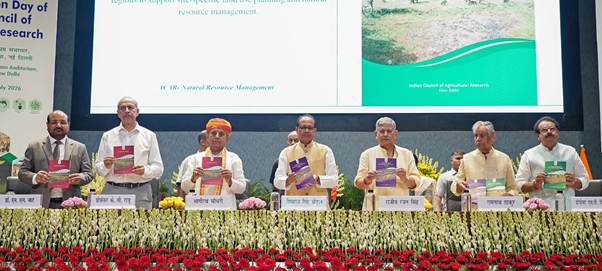
The Indian Council of Agricultural Research (ICAR) celebrated its 98th Foundation Day by reaffirming its commitment to science-driven, climate-resilient, and farmer-centric agricultural development. The occasion highlighted significant achievements in agricultural research and innovation while outlining a strategic roadmap for supporting the vision of Viksit Bharat 2047.
Addressing the gathering, Union Minister for Agriculture & Farmers’ Welfare and Rural Development Shivraj Singh Chouhan described ICAR as the driving force behind India’s agricultural transformation. “If farmers are the soul of agriculture, scientists are its brain,” he said, emphasizing that research, innovation, and technology will form the strongest foundation for achieving the goal of a developed India by 2047.
The event was attended by Union Minister for Fisheries, Animal Husbandry, Dairying and Panchayati Raj Rajiv Ranjan Singh, Ministers of State Ramnath Thakur, Bhagirath Choudhary, and Prof. S.P. Singh Baghel, NITI Aayog Member K.V. Raju, Secretary, Department of Fisheries Naresh Pal Gangwar, Secretary (DARE) and ICAR Director General Dr. M.L. Jat, along with vice-chancellors of agricultural universities, scientists, industry representatives, farmer organizations, and students.
Nearly a Century of Agricultural Leadership
Observed every year on 16 July, ICAR Foundation Day commemorates the establishment of the Council in 1928. Over the past 98 years, ICAR has played a pivotal role in strengthening India’s agricultural research, education, and extension system. From supporting the Green Revolution to developing improved crop varieties, livestock technologies, fisheries innovations, and climate-smart farming practices, ICAR has been instrumental in ensuring the nation’s food and nutritional security.
Today, India ranks among the world’s leading producers of food grains, horticultural crops, milk, and fisheries products, with ICAR’s scientific research contributing significantly to this achievement.
386 Improved Crop Varieties Developed in 2025–26
Highlighting ICAR’s achievements during 2025–26, Shivraj Singh Chouhan announced that the organization developed 386 improved varieties across 44 different crops within a single year.
A major milestone was that 94% of these varieties are climate-resilient, specifically designed to withstand the challenges posed by climate change, rising temperatures, and erratic rainfall. In addition, 29 varieties are biofortified, offering enhanced nutritional value compared to conventional varieties.
The Minister noted that climate-resilient crops are essential for reducing production risks, improving farm productivity, and ensuring stable incomes for farmers in the face of changing weather conditions.
Demand-Driven Research for Farmers
Chouhan emphasized that India’s agricultural future depends on close collaboration between farmers, scientists, and policymakers. He urged researchers to prioritize demand-driven research that directly addresses farmers’ field-level challenges and delivers practical, affordable, and scalable solutions.
He also stressed the need to achieve greater self-reliance in pulses and oilseeds, reducing dependence on imports through advanced crop varieties, modern farming technologies, and stronger agricultural research.
Strengthening Extension and Technology Transfer
Speaking at the event, Union Minister Rajiv Ranjan Singh highlighted the crucial role of Krishi Vigyan Kendras (KVKs) in transferring scientific innovations from laboratories to farmers’ fields. He said that agricultural research becomes truly successful only when technologies are widely adopted by farmers.
He also noted that the collaboration between ICAR and the Department of Animal Husbandry and Dairying would accelerate research, innovation, and technology transfer in livestock, dairy, and fisheries, contributing to higher rural incomes.
Science-Based Agriculture for Viksit Bharat
Minister of State Ramnath Thakur stated that the remarkable progress achieved in agriculture and dairy sectors reflects the government’s commitment to farmers’ welfare, while Bhagirath Choudhary emphasized the importance of scientific research in promoting natural farming, improving soil health, and increasing pulse and oilseed production.
Meanwhile, Prof. S.P. Singh Baghel underlined the role of advanced technologies such as sex-sorted semen, artificial insemination, embryo transfer, fisheries innovations, natural farming, micro-irrigation, and nano-fertilizers in increasing farmers’ income and building a developed India.
Research Adds ₹55,000 Crore to the Economy
Presenting ICAR’s annual achievements, Dr. M.L. Jat, Secretary (DARE) and Director General of ICAR, revealed that increased production in crops, horticulture, livestock, and fisheries generated an estimated ₹1.70 lakh crore in additional economic value during 2025–26.
Of this, agricultural research alone contributed nearly ₹55,000 crore, demonstrating the significant economic returns generated through investments in agricultural science and innovation.
He also reported that ICAR technologies directly reached around one crore farmers during the year, while digital and social media platforms disseminated scientific agricultural information to over five crore farmers. Additionally, ICAR signed 18 international MoUs, strengthening global collaboration in agricultural research.
New Technologies and Commercialization
During the Foundation Day celebrations, ICAR dedicated 43 improved crop varieties, 17 advanced agricultural technologies and products, and 14 important publications to the farming community.
Key innovations included new Basmati rice varieties, climate-resilient rice for saline and alkaline soils, export-oriented mango production technologies, India’s first indigenous African Swine Fever (ASF) vaccine, a Digital Swine Disease Atlas, and a low-cost cassava harvester for small farmers.
To accelerate technology commercialization, ICAR signed 72 Memoranda of Understanding (MoUs) with 51 industry partners, facilitating the transfer of improved seeds, farm machinery, vaccines, and agricultural innovations to farmers.
The event also witnessed the regularization of 150 daily wage employees, reflecting ICAR’s commitment to strengthening its human resources.
Concluding the celebrations, ICAR reaffirmed its commitment to advancing science-based research, climate-smart agriculture, digital innovation, and farmer-focused technologies. Experts believe these efforts will play a critical role in making Indian agriculture more sustainable, competitive, and resilient, paving the way for “Developed Agriculture, Prosperous Farmers, and Viksit Bharat 2047.”


 By
By