

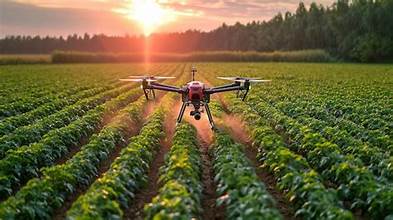
Artificial Intelligence (AI), drones, satellite imaging, robotics, and precision farming technologies are revolutionizing agriculture across the world, offering farmers smarter ways to improve productivity, reduce production costs, and make farming more sustainable. As climate change, labour shortages, and rising input costs continue to challenge the agricultural sector, countries are increasingly adopting digital farming solutions to enhance efficiency and ensure long-term food security.
Experts believe that the integration of AI into agriculture marks one of the biggest technological transformations in farming history. Modern AI-powered systems can analyze vast amounts of data collected through satellites, sensors, weather stations, and drones to provide farmers with real-time insights into crop conditions. These technologies help growers make informed decisions about irrigation, fertilization, pest management, and harvesting, ultimately improving yields while minimizing waste.
Agricultural technology companies are developing advanced AI platforms capable of monitoring crop health with remarkable accuracy. Using machine learning algorithms and high-resolution satellite imagery, these systems can identify nutrient deficiencies, detect diseases at an early stage, and monitor pest infestations before they spread across fields. Early detection enables farmers to take timely corrective measures, reducing crop losses and lowering the need for excessive pesticide applications.
Drones have become an essential tool in precision agriculture. Equipped with multispectral cameras and advanced imaging technology, drones can survey large agricultural fields within minutes, generating detailed maps that highlight variations in crop growth and soil conditions. Farmers can use this information to apply fertilizers, pesticides, and water only where they are needed, reducing unnecessary input use and improving overall resource efficiency.
Precision irrigation systems are also transforming water management in agriculture. AI-powered irrigation scheduling combines weather forecasts, soil moisture data, and crop growth models to determine the exact amount of water required by crops. This targeted approach helps conserve water, lowers energy consumption, and improves crop performance, particularly in regions experiencing water scarcity due to climate change.
Industry experts estimate that precision agriculture can reduce fertilizer and pesticide usage by up to 30 percent, significantly lowering production costs while minimizing environmental pollution. Controlled application of agricultural inputs also reduces nutrient runoff into rivers and groundwater, supporting healthier ecosystems and sustainable farming practices.
Autonomous tractors, robotic weeders, and AI-guided harvesting machines are further reducing dependence on manual labour. These smart machines can perform field operations with greater precision, operate for longer hours, and improve operational efficiency. As labour shortages continue to affect agriculture in many countries, automation is becoming an increasingly important solution for maintaining farm productivity.
Governments across Europe, North America, and Asia are actively promoting digital agriculture through supportive policies, innovation grants, research programmes, and farmer training initiatives. Public-private partnerships are investing heavily in agricultural technology startups that develop AI-based farm management systems, precision sensors, automated machinery, and digital advisory platforms.
Several universities and agricultural research institutions are collaborating with technology companies to create localized AI models capable of addressing region-specific farming challenges. These innovations include crop forecasting systems, disease prediction models, climate advisory services, and decision-support tools that help farmers respond effectively to changing weather patterns.
The growing availability of cloud computing, mobile applications, and Internet of Things (IoT) devices has made advanced farming technologies more accessible to farmers. Mobile-based digital platforms now provide weather forecasts, market prices, crop recommendations, and pest alerts directly to farmers, enabling them to make timely management decisions from their smartphones.
Agricultural economists believe that precision farming not only increases productivity but also strengthens farm profitability by optimizing resource utilization. By reducing unnecessary input costs, minimizing crop losses, and improving operational efficiency, farmers can achieve higher returns while adopting environmentally responsible practices.
Industry analysts predict that the global precision agriculture market will witness strong growth over the next decade as climate variability, population growth, and increasing food demand drive investment in smart farming technologies. Continuous advances in artificial intelligence, satellite analytics, remote sensing, and robotics are expected to further accelerate technology adoption across both developed and developing nations.
As agriculture enters a new digital era, AI and precision farming are emerging as key drivers of sustainable food production. Experts believe that continued innovation, supportive government policies, affordable technologies, and farmer education will play a crucial role in building resilient agricultural systems capable of meeting future food security challenges while protecting natural resources and improving farmers’ livelihoods.


 By
By











