

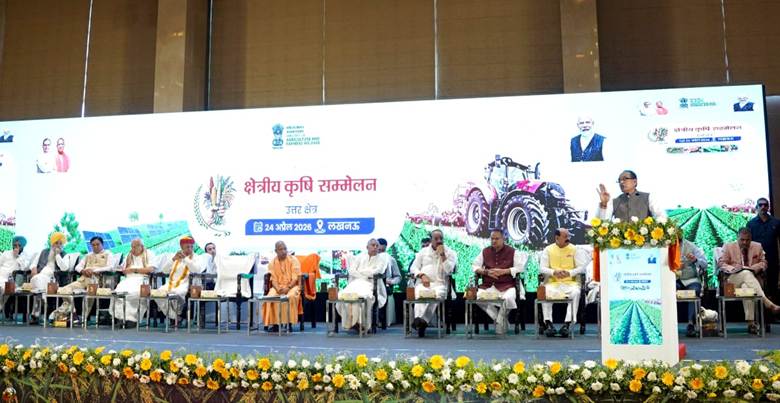
A major Northern Region Agriculture Conference held in Lucknow has set the tone for a more localized, technology-driven, and farmer-centric approach to agricultural development in India. Organized by the Ministry of Agriculture and Farmers Welfare, the conference brought together policymakers, scientists, progressive farmers, and stakeholders to deliberate on region-specific strategies aimed at enhancing farm productivity and income.
The event was attended by Union Agriculture and Farmers Welfare Minister Shivraj Singh Chouhan and Uttar Pradesh Chief Minister Yogi Adityanath, along with ministers and representatives from several northern states and Union Territories. The central focus of the conference was to move away from a “one-size-fits-all” agricultural policy and instead promote region-specific planning based on local agro-climatic conditions.
Addressing the inaugural session, Shivraj Singh Chouhan emphasized that India’s diverse geography, soil types, and climatic variations require tailored agricultural strategies. He urged states to develop clear, long-term roadmaps aligned with their regional strengths and challenges. According to him, the future of Indian agriculture depends on achieving three key goals: ensuring food security, increasing farmers’ income, and providing nutritious food to citizens.
He stressed that merely increasing production is not enough; reducing input costs, ensuring fair prices for produce, compensating crop losses, and promoting diversification are equally critical. Highlighting the risks of overdependence on traditional wheat-paddy systems, he advocated for diversification into pulses, oilseeds, horticulture, and value-added agriculture.
The Union Minister also raised concerns over the excessive use of chemical fertilizers and its adverse impact on soil health. He called for balanced nutrient management, promotion of natural farming practices, and strict action against counterfeit seeds, fertilizers, and pesticides. Ensuring quality agricultural inputs, he noted, is essential for sustainable productivity and farmer welfare.
Chouhan further underlined the importance of improved seed availability, the implementation of Farmer ID systems, and wider access to the Kisan Credit Card (KCC) scheme. These initiatives, he said, would enhance transparency, streamline benefits, and provide affordable credit to small and marginal farmers. He also highlighted the need to strengthen the “Lab to Land” initiative, ensuring that scientific innovations reach farmers directly through field-level engagement.
For smallholders, he recommended adopting integrated farming systems that combine crop cultivation with allied activities such as livestock rearing, fisheries, beekeeping, and agroforestry. This approach, he explained, can create multiple income streams and reduce dependency on a single crop.
Chief Minister Yogi Adityanath, in his address, described the regional conference model as a practical and result-oriented initiative. He pointed out that different agro-climatic zones present unique challenges and opportunities, making localized planning more effective. Referring to the “Viksit Krishi Sankalp Abhiyan,” he said scientific research is now reaching farmers more efficiently, enabling faster adoption of modern techniques.
He emphasized that agriculture should not be limited to production alone but must be linked with income generation, technology adoption, and market access. Highlighting Uttar Pradesh’s progress, he noted that many farmers are shifting toward multi-cropping systems and integrated models, leading to improved earnings.
The conference also focused on aligning agriculture with food processing and market systems to ensure better price realization for farmers. Discussions covered key areas such as preparedness for upcoming Kharif and Rabi seasons, crop diversification, technology transfer, and market strategies.
Overall, the Lucknow conference emerged as a significant platform for shaping future agricultural policies. It reinforced the idea that Indian agriculture must evolve into a more scientific, regionally adaptive, and farmer-focused sector to meet the challenges of the coming decades.


 By
By











